Amodura A/D monogram in black.

AMODURA

The work should standwithout its maker.

Independent philosophical publishing.

Human nature · Identity · Self-command Explore the work

Amodura publishes original philosophical reflections on the human condition — on who we are, how we see, and how we live with one another.

Its writing begins with familiar experiences and examines the assumptions beneath them. Through questions of identity, perception, relationships and self-command, each reflection invites careful attention to what we usually leave unquestioned.

Five works from an ongoing enquiry
into the experience of being human.

01 Judgement

First Principles
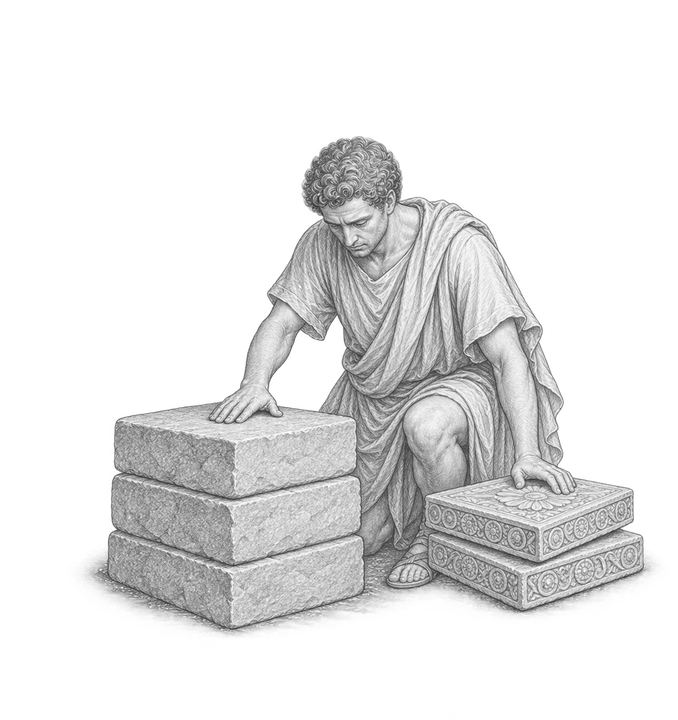
A kneeling figure examining plain stone blocks and carved slabs.

Many judgements begin with an assumption that has never been examined. An expectation is inherited, a rule repeated, or a fear absorbed from the surrounding environment. Over time, what was learned begins to feel self-evident.

Continue readingClose reflection — First Principles

A person may then work harder to satisfy a requirement that the task does not actually impose.

Someone wants to learn a craft but believes serious work cannot begin without the best equipment. They compare tools, postpone practice and treat the cost of an ideal setup as the cost of entering the craft itself.

Returning to first principles asks a different question: what does the next useful act of learning genuinely require? Perhaps it needs a safe, functional tool, suitable material, time to practise and a way to recognise an error. Better equipment might eventually help. It does not follow that every improvement must be acquired before a first attempt.

The examination separates the purpose from the customary route towards it. What is known? What is necessary? Which condition makes the action possible, and which merely makes it familiar, impressive or more convenient?

This does not require suspicion towards everything inherited. Many received principles preserve useful knowledge. A practice that survives examination need not be rejected because someone else developed it.

Equally, a personally chosen belief is not true merely because it feels independent. Its foundation still needs reasons.

More effort cannot correct a mistaken requirement while that requirement remains untouched. It may only build a larger structure around the same obstacle.

Clear judgement begins when the person is willing to return beneath the existing explanation and examine what supports it. Sometimes a complicated problem becomes smaller because one of its supposed necessities was never necessary at all.
02 Identity

The Shape of Stones

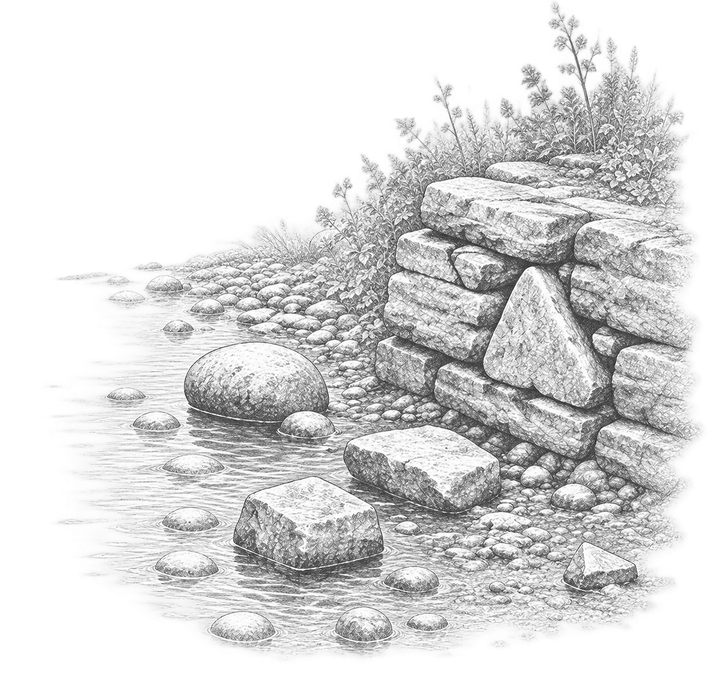
A rocky stream beside a stone embankment.

No two stones beside a river carry exactly the same form. Their colour, weight, hardness and surface belong to different histories. One is smooth and rounded; another has a rough face or a broken edge sharp enough to cut. Contact with the world has left traces in the material.

Continue readingClose reflection — The Shape of Stones

Human character also develops through contact. Family, culture, loss, work, opportunity and resistance shape what becomes familiar to us. Some experiences harden our responses. Others soften them, sharpen perception or wear away a way of living that could no longer continue unchanged.

The mistake is to treat these differences as a simple hierarchy. A stone unsuited to a cutting edge may bear weight. A rough surface can shape another material. Sand, easily scattered grain by grain, can become part of glass and structures no single stone could create.

Difference does not mean that every limitation must be accepted without examination. The metaphor has a boundary: a stone cannot question where it has been placed. A person can.

We can examine surroundings that damage us and look for ways to change them, although leaving may require time, resources or help. We can practise what remains undeveloped and reconsider responses that experience made unnecessarily hard.

Yet becoming equally suited to every demand is not a useful standard. The task is not to imitate every strength we observe in others. It is to understand what we bring: what we notice, what we can sustain, what we can build and where those capacities meet something needed.

Comparing shapes tells us little if we have not asked what each is being asked to do. Purpose becomes easier to recognise where personal nature, developed ability and a real need meet. Difference can then become a question of contribution rather than rank.

03 Self-command

The Strength That Needs No Rival

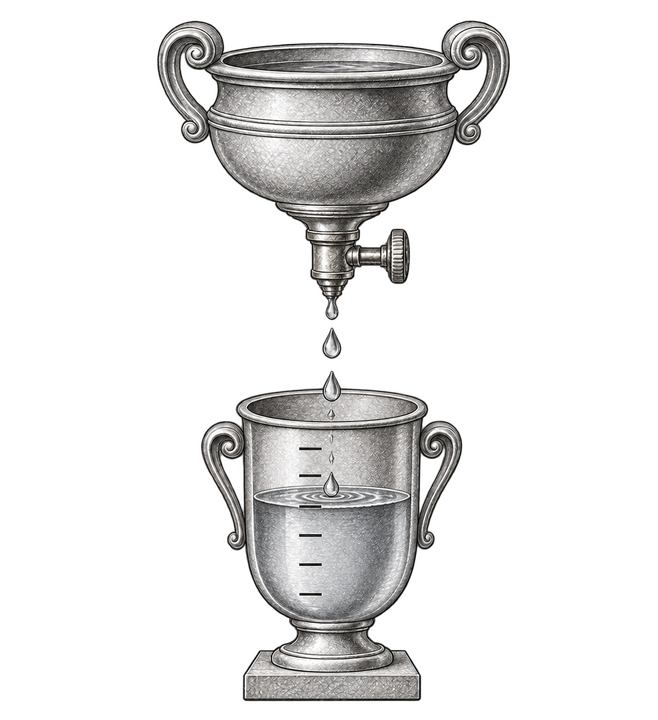
Water falling from an ornate vessel into a measuring cup.

Resistance does not always arrive as a dramatic conflict. Sometimes it speaks calmly: the task can wait, the energy is not right, a more motivated version of us will complete it later.

Continue readingClose reflection — The Strength That Needs No Rival

Each reason may sound temporary. But when the same necessary work is postponed repeatedly, a commitment begins to seem binding only while the feeling supports it.

Acting through this resistance creates more than a finished task. It provides evidence that discomfort can be present without deciding the action, and that absent motivation does not always mean absent capacity. Over time, this evidence changes how a person understands their reliability. They have seen themselves continue with something they judged worthwhile when withdrawal was easier.

But that progress becomes distorted when it is converted into superiority. If it matters only when it places us above someone else, another person's weakness becomes reassuring and their development becomes threatening. Attention moves away from the standard being built and towards the rank being defended.

External judgement should not be dismissed. Other people can reveal blind spots we cannot see alone. Yet praise and comparison cannot settle whether we acted in accordance with a sound commitment. That requires honest observation of what was chosen, what was needed and what actually followed.

Not every resistance should be defeated. Exhaustion may require recovery, pain may reveal injury, a method may need correction and a goal may no longer deserve loyalty. Self-command involves examining resistance rather than permanently refusing to stop.

When the task remains necessary and the conditions remain sound, action need not wait for enthusiasm. A fulfilled commitment can make us more credible to ourselves without making us more valuable than someone else.

The purpose is to become less governed by passing states, not to find reassurance in another person's difficulty. Strength that requires a rival remains dependent on comparison. A standard grounded in examined conduct can remain meaningful without one.

04 Relationships

Love Without Ownership

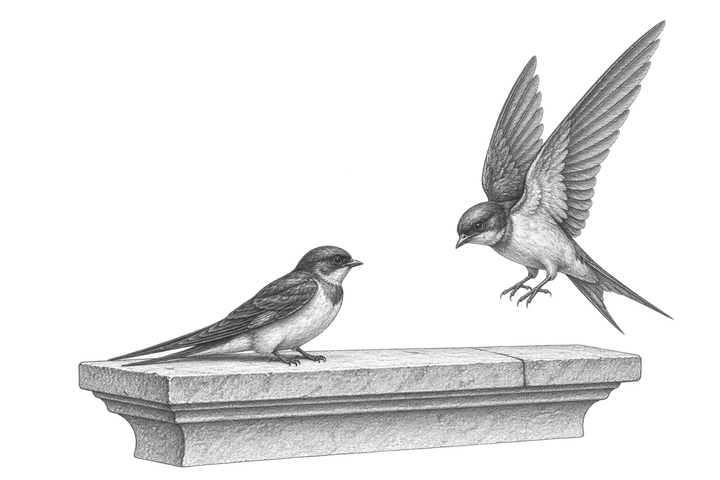
Two swallows, one perched and one with its wings spread.

Closeness can create a desire for certainty. When another person becomes important, their attention may begin to feel necessary. Distance feels threatening, and independent choices seem to signal weakening affection.

Continue readingClose reflection — Love Without Ownership

Fear of losing someone produces an impulse to control what cannot be guaranteed. Questions become surveillance, concern becomes restriction and reassurance is repeatedly demanded. This may be called love, although wanting someone close has begun to turn into a claim of authority over them.

Wanting to be chosen is human. Expecting that choice to be continually proven through obedience asks for something different. A relationship may contain commitments and boundaries, but commitment requires consent. Ownership begins when one person assumes the right to command the other.

Another person can offer loyalty, presence and honesty. They cannot become an extension of someone else's will. Each carries a separate inner world, with needs and sources of meaning that may differ. Closeness does not erase these differences or make their surrender the price of security.

Control may produce compliance without creating trust. The controlled person may adjust their behaviour to avoid conflict, offer reassurance to prevent accusation or abandon relationships and interests because keeping peace is easier than defending their freedom. The bond looks intact from outside while presence increasingly depends on permission. Control also creates the uncertainty it was meant to remove. When someone stays under pressure, it is difficult to distinguish love from fear, exhaustion or dependency. The attempt to secure affection weakens the freedom that gave affection its meaning.

Respecting freedom does not mean accepting every action without consequence. A choice may break an agreement, reveal incompatibility or require the relationship to end. The response lies in deciding what we will participate in, rather than claiming authority over another person's will.

Loving without ownership is an active practice. It involves stating what matters, asking honestly and allowing the other person to remain separate. Where trust cannot be restored, ending the relationship may be necessary; control cannot supply what is missing.

Two lives can share direction without becoming one will. Their closeness has meaning because both remain capable of choosing it, and neither uses fear as a claim over the other.

05 Release

Release Without Return

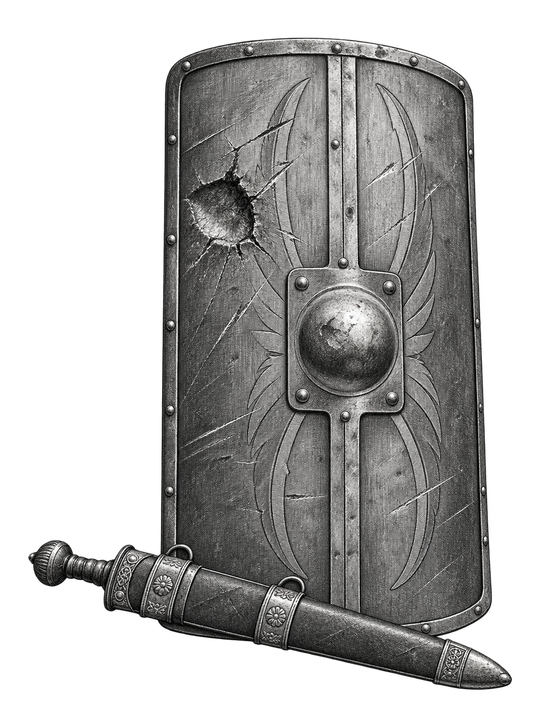
A damaged shield beside a sheathed sword.

Letting go of anger can seem like giving something to the person who harmed us. It may feel like a pardon, a victory for them or an admission that the injury was insignificant. Anger then becomes a duty: we must keep feeling it so that the truth of what happened remains visible.

Continue readingClose reflection — Release Without Return

But accountability does not rest on maintaining one particular feeling. The facts remain true when we are occupied with something else, when an ordinary day brings enjoyment or when the wish to argue has weakened.

Release does not mean declaring that the act was acceptable. It does not require forgetting, forgiveness or renewed contact. Trust may remain withdrawn, and a boundary may remain permanent. Sometimes turning away is the clearest available response.

Nor is release a single decision that removes every effect. Grief, caution and bodily reactions may remain. Practical consequences may still need attention, and recovery may take time. None of this means we have failed to make the right choice.

What can change is the belief that anger must be kept alive as evidence. We can notice when an inner argument no longer serves an action, or when revenge is being asked to restore something it cannot recover. There is no obligation to reopen that argument whenever attention has begun to move elsewhere.

Acceptance acknowledges that the event happened. It does not approve it or cancel what remains to be addressed. It allows care for the present to have a place beside the history of the harm.

A person can remain outside our life without every future choice being organised around them. Attention can gradually become available for relationships, work and ordinary experiences that have no role in the original conflict.

Release cannot return the time already taken or undo what was lost. It can make room for a life whose meaning is no longer measured by continued opposition to the person who caused the injury.

The Human Condition — original Amodura artwork.

The Human Condition

A philosophical work in progress.

The Human Condition brings together self-contained reflections on the everyday experiences and enduring questions of being human.

Each text can be read on its own. Together, they explore the patterns of thought, feeling and conduct that shape a life.

In development

Follow the work.

Instagram — @amo.dura (opens in a new tab)

ciao@amodura.com